What to evaluate before installing commercial EV chargers
Site assessment checklist for commercial charging projects
Adding electric vehicle charging to a commercial property is more involved than ordering a few units and mounting them on a wall. The equipment you see above ground is only the last piece of a system that starts at the utility transformer and runs through panels, conduit, and parking lot pavement. A thorough site assessment catches constraints early, before designs are drawn and budgets set. Below are the key points to check, each with a short explanation of why it matters.
Parking capacity and layout
The first question is not how many chargers you want but how many parking spaces you have and how they are arranged. Charging stations need a dedicated spot per connector, and those spots must be accessible without blocking traffic flow or other parked cars. Look at the dimensions of your parking lot or structure. Standard spaces work for most Level 2 chargers, but if you plan for DC fast charging, you may need pull-through spaces or wider stalls to accommodate vehicles that charge at the front or rear. Also consider future expansion: can the lot accommodate more charging spaces later without major reconfiguration? The layout affects trenching, conduit runs, and whether you can serve multiple rows from one power source.
Utility service and load profile
Commercial charging infrastructure draws significant power, especially if you install multiple units. You need to know the existing electrical service capacity at the site and how much spare capacity is available. A load profile study by a licensed electrician can show peak demand times and whether the current transformer and main panel can handle the added load. In many cases, the utility will need to upgrade the service transformer or run a new feed, which can add months to the timeline and significant cost. Early conversations with the utility company help you understand lead times, fees, and any demand-charge tariffs that apply. If the site already has heavy loads such as HVAC or industrial equipment, you may need load management software to avoid tripping breakers or incurring high demand charges.
Parking lot condition and underground obstacles
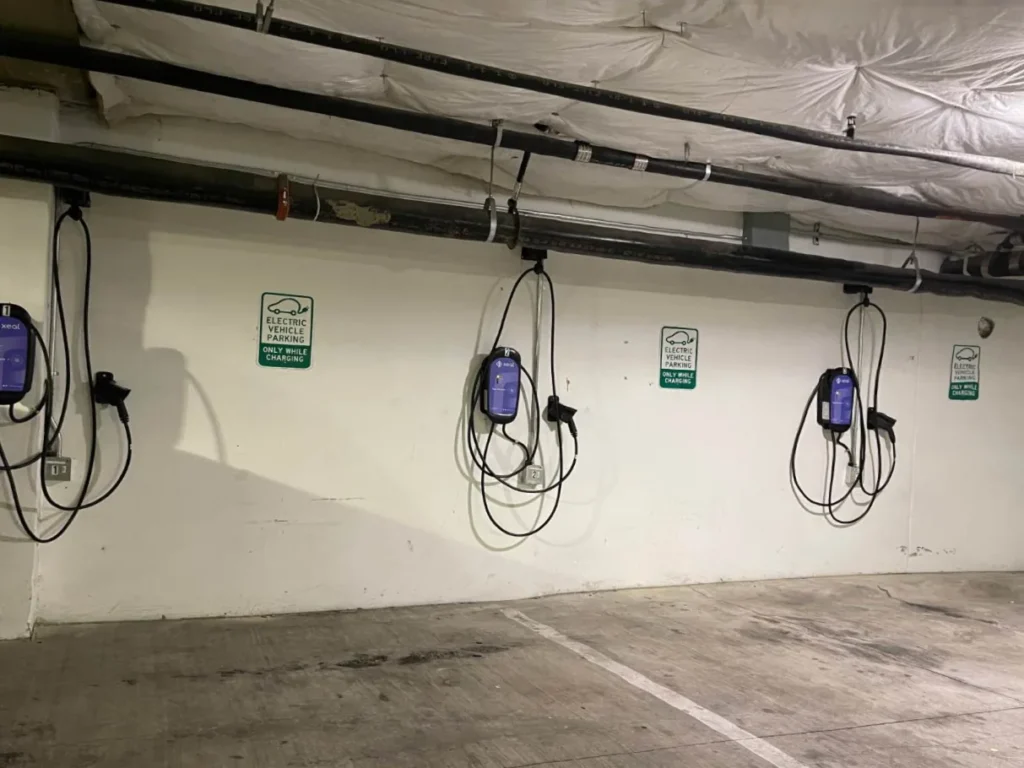
Running conduit from the electrical room to the parking spaces usually involves trenching through asphalt or concrete. Before you plan a route, check the condition of the pavement. Old, cracked pavement may need replacement anyway, so it can be cost-effective to coordinate charging installation with a repaving project. More importantly, verify what lies beneath. Utility lines, gas pipes, water mains, telecom cables, and old foundations can block a straight trench. A private utility locate service (beyond the public one-call mark) is recommended because the public locate often misses private lines on the property. If the parking lot has lighting poles, irrigation, or drainage, those also affect where you can place chargers and run conduit.

Tenant demand and usage patterns
Understanding who will use the chargers and when is essential for sizing the system. If the property is a mixed-use building or an apartment complex, survey current and prospective tenants. The phrase EV charging for multifamily properties requires particular attention to parking allocation: will chargers be assigned to specific units, or will they be shared among residents? Shared chargers need a reservation or queuing system, while assigned chargers simplify billing but may sit idle. For office or retail sites, consider employee shift times and customer dwell times. A grocery store with thirty-minute visits may need fewer but faster chargers, whereas an office where people park for eight hours can use slower, lower-cost units. Matching charger power and quantity to actual use avoids overspending on capacity that never gets used.
Access control and networked charging
Commercial chargers are not like home units where you plug in and walk away. You need a way to manage who can charge, how they pay, and how you recover electricity costs. Access control can be RFID cards, mobile apps, or plug-and-charge authentication. Networked charging stations communicate with a backend platform that tracks usage, processes payments, and may apply different rates for different user groups. For properties with multiple buildings or phased deployment, the network should support grouping and remote management. Check whether the site has reliable cellular or Wi-Fi coverage in the parking area; if not, you may need to run data cabling or install a signal booster. The access control system also affects the user experience: a complicated login process discourages use, while simple tap-and-charge encourages adoption.
Local permitting and code requirements
Every jurisdiction has its own rules for commercial charging installations. Some require a building permit, an electrical permit, and possibly a zoning review. The National Electrical Code (NEC) has specific articles for EV charging equipment, including requirements for ground-fault protection, disconnecting means, and working clearances around the equipment. Local amendments may add requirements such as signage, bollards to protect the chargers, or accessibility standards for disabled users. Your site assessment should identify the applicable codes early, because they affect equipment placement, conduit sizing, and panel location. In some cities, the permitting process also triggers a review by the fire department if the chargers are in a parking structure or near a building. A pre-application meeting with the building department can surface issues before you submit plans.
Budgeting for soft costs
Hardware is only part of the total cost. Site assessment also means estimating the soft costs: engineering and design fees, permit fees, utility connection charges, and the cost of trenching, concrete work, and pavement restoration. For properties with older electrical systems, upgrading the main panel or transformer may be the single largest expense. Some utilities offer rebates or incentives for commercial charging installations, but those often require pre-approval and specific equipment choices. Your site assessment should include a review of available incentives and their application deadlines, because they can significantly change the project economics. Also factor in ongoing costs such as network subscription fees, maintenance, and electricity. A realistic budget accounts for all these elements, not just the sticker price of the chargers.
Future-proofing the installation
EV adoption is growing, and the charging needs of a site will likely increase over time. A good site assessment plans for that growth. Can the electrical room accommodate additional breakers? Is there space in the conduit for more conductors? Will the parking lot layout allow more chargers without re-trenching? If you install a transformer with extra capacity now, future upgrades become simpler and cheaper. Similarly, choosing a scalable network platform lets you add chargers without switching software. The phrase EV charging for multifamily properties often involves phased rollouts: install a few chargers first, see how they are used, then add more. Designing the infrastructure to support that from day one avoids tearing up the parking lot twice.
A thorough site assessment turns a commercial charging project from a wish list into a feasible plan. Each item on this checklist interacts with the others: parking layout affects conduit routing, which affects electrical load, which affects utility coordination. By evaluating all of them together, you avoid surprises later and get a system that works for the property, the users, and the budget.